๏ Spring Hill KS, 66083

๏€ƒ  dovewebconsulting@gmail.com

Content Marketing Management

You published the article in March. It cost a morning, or it cost a writer. Six months on, nobody in the building can say whether anyone read it, and the report says it gained visibility.


An article is a page that has to earn a click and then send the reader somewhere. That is the whole job: write for a search that exists, link the article into the site, give it a next step, and read the numbers every month. My own blog's last ninety days are on this page, because that is what the numbers look like before those four things are done. For businesses in the Kansas City metro: Spring Hill, Olathe, Overland Park and the neighborhoods between.

A laptop showing an article page chained to a second page, with a marked calendar, a pencil, a share bubble and a phone icon.

What ninety days of my own blog look like


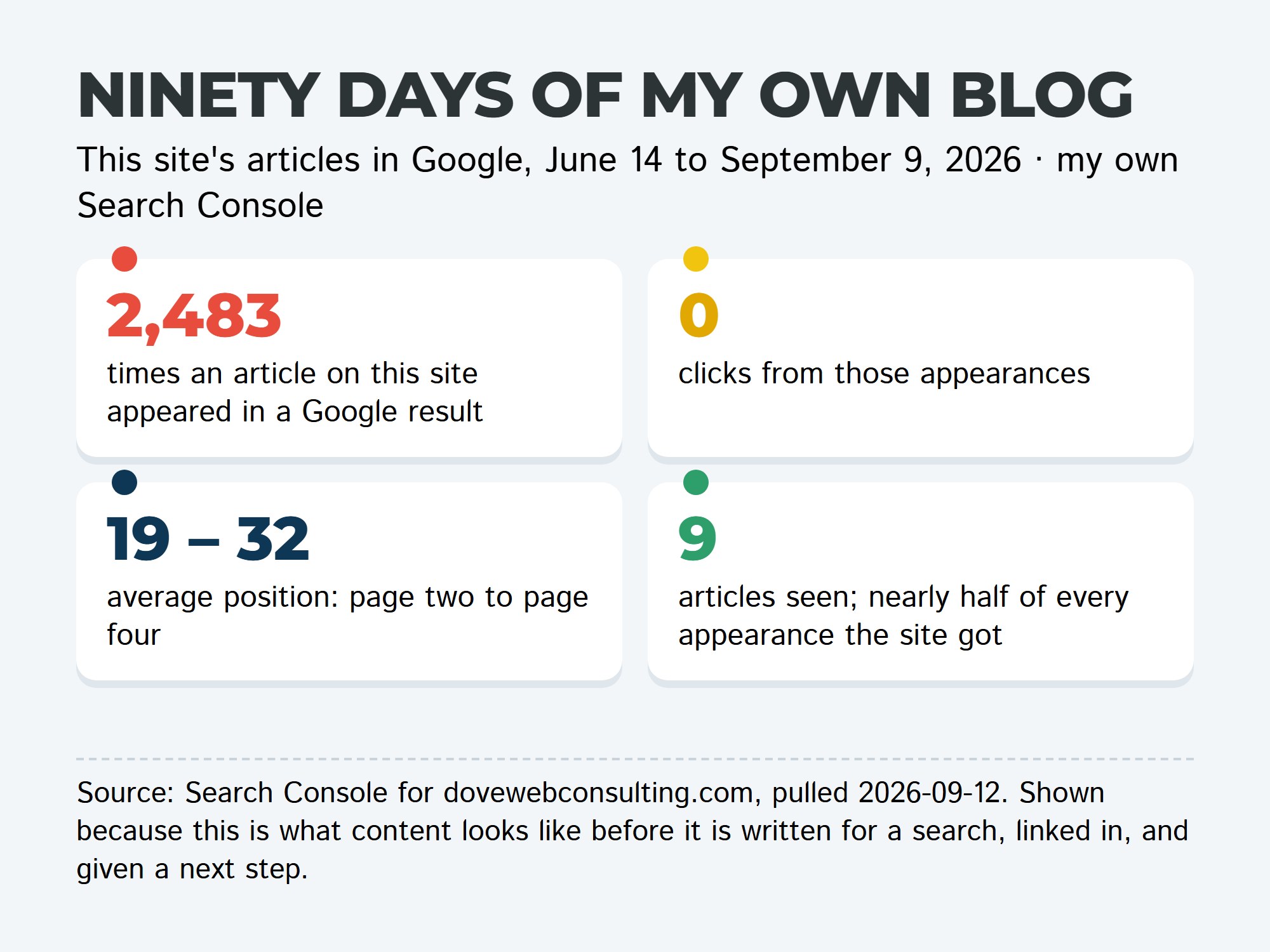
Between June 14 and September 9, 2026, nine articles on this site appeared in Google results 2,483 times. They were clicked zero times. Their average positions ran from 19 to 32, which is page two to page four. Nearly half of every appearance this site got in those ninety days came from those articles, and not one of them brought a visitor.


That is not a complaint about Google. It is what "gained visibility" means when the article is not written for a search that exists, is not linked from the pages people do reach, and gives the reader no reason to click. The numbers are in my own Search Console and I would rather show them than promise you traffic.


The oldest post on this site is seen more than any other page here and it is the first one on the refresh list. That is where the work starts on any site: with what is already published.

Four plates: 2,483 appearances in Google, zero clicks, positions 19 to 32, nine articles, this site's own ninety days.

Nothing points at it


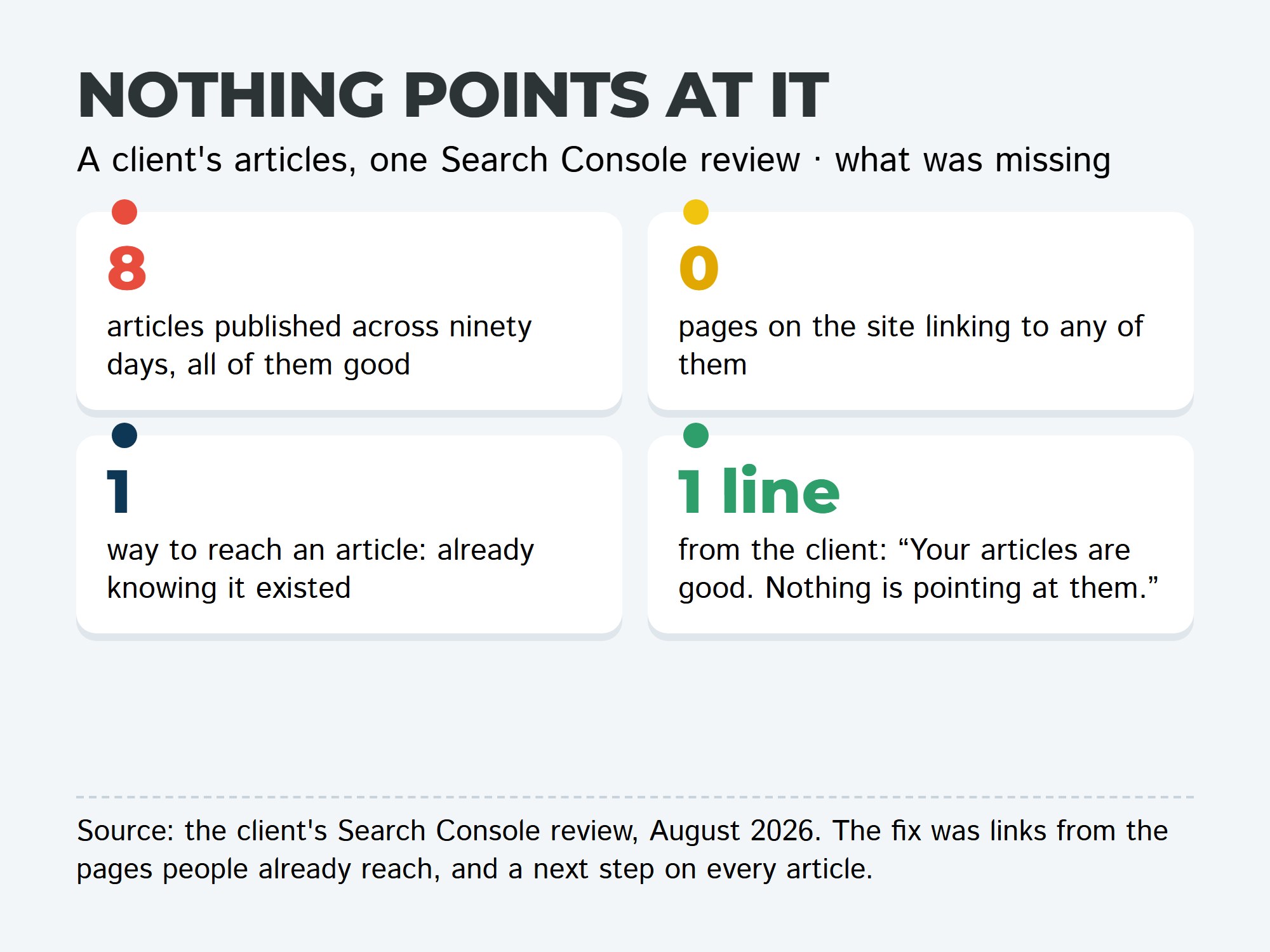
A client had eight articles published across ninety days. The writing was good. Not one page on the site linked to any of them, so the only way to reach an article was to already know it existed. Her words, from her own Search Console review: "Your articles are good. Nothing is pointing at them."

Four plates: eight good articles in ninety days, zero pages linking to them, one way to reach them, one line from the client.
An article page with an empty dashed slot at the bottom where the next step button should be, a red arrow pointing at it.

A second owner reviewed a post I had drafted for his site and sent back one edit: add a book-a-free-consult at the bottom. He was right, and it is the edit most articles never get. A post with no next step is a form and a hope.


The third record is smaller: a shop's blog that lived at an address full of question marks, with comment spam showing and not one photo of the work they do. Content marketing on that site would have started with moving the blog, not writing for it.

I will not write the article yet if

There is no page to send them to


An article earns a click and then has to send the reader somewhere that can take the call. If that page does not exist, the article is a dead end with good grammar. Build the service page first: web design and development.

There is no search behind the topic


A quota is not a calendar. Two posts a month about whatever came up is how a blog earns 2,483 appearances and no clicks. Whether the search exists is the search engine optimization page's job; this page starts once it does.

You want social posts for a site that cannot convert


Social posts are how an article gets distributed, and they are part of this work. On their own they send people to a page that loses them; if the form does not reach a human, read the lead handoff nobody owns first.

The honest answer for all three is to spend the money somewhere else first. Ask me and I will say so.

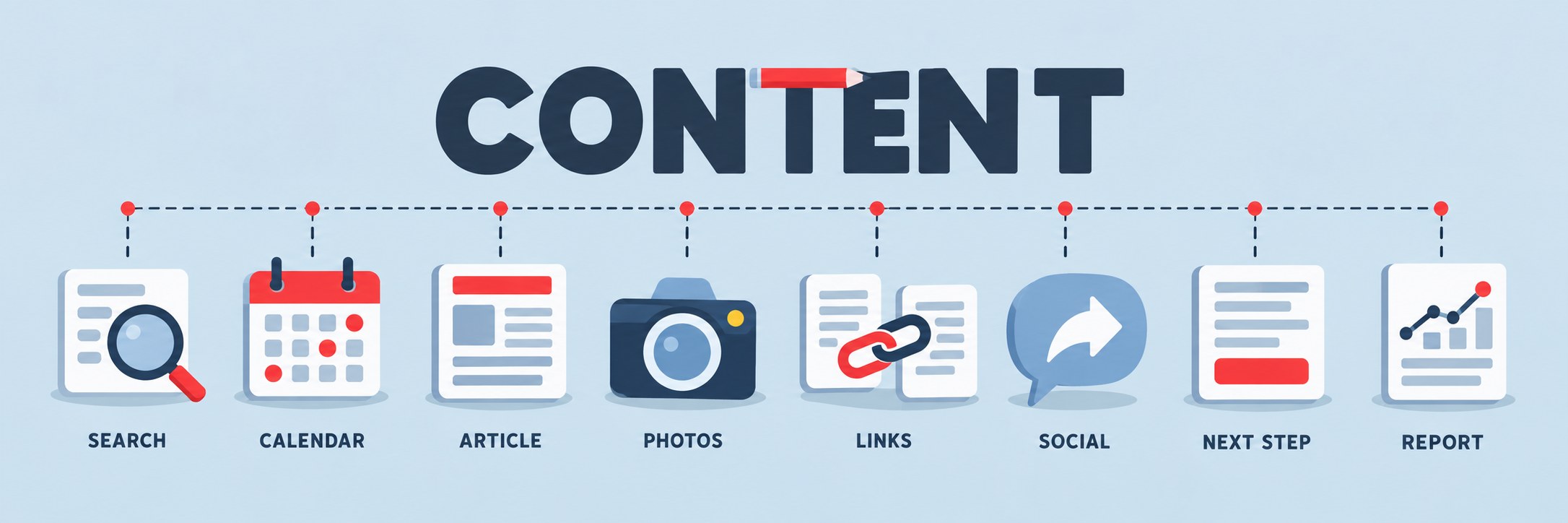
Content banner with eight icons for search, calendar, article, photos, links, social, next step and report.

Content Marketing Services


A calendar page with three red dots, the calendar from search data icon

Calendar from search data


Topics come from what people in your area type into Google, read out of Search Console and the keyword data, and each topic is checked against what you have already published so nothing gets written twice.

A page with a headline bar and a pencil, the articles written to a spec icon

Articles written to a spec


Every article carries something only your business could say: a job you did, a number you measured, a case where you told a customer no. Written in your voice, in plain American English, with no filler.

Two small pages joined by a chain link, the internal links and next step icon

Internal links and a next step


Every article is linked from the pages people already reach, links out to the service it supports, and ends with one next step: a call, a form or a booking. The edit most articles never get, made on every one.

A speech bubble with a curved share arrow, the social distribution icon

Social distribution


Each article is cut into posts for the channels your customers actually use, published on a schedule, pointing back at the article and the page behind it. Social media management lives here, as distribution, not as a separate bill. The readers who leave an address become the list that email marketing sends the offer to.

A page with a circular refresh arrow, the refresh not rewrite icon

Refresh, not rewrite


The articles you already have are the first job: the ones being seen and not clicked get a new opening, a real title, links in and out, and a next step. A page that already appears is worth more than a new one.

A report page with a small sparkline, the monthly content report icon

Monthly content report


Which pages were seen, which were clicked, which queries carried them, and what gets written or refreshed next. One page, read in a minute, with a decision in it.

Ready for content?


Ready for content? Three questions.

1. Is there a page on your site that an article could send a reader to, where they can call or book?

2. Do you know which searches people in your area make before they need what you sell?

3. Did the last thing you published get a single click from a search you can point to?

Answer the three questions and the verdict appears here.

Nothing you click here is sent anywhere. It runs on this page only.

Three questions, twenty seconds. If the answer is no, this page just saved you a morning.

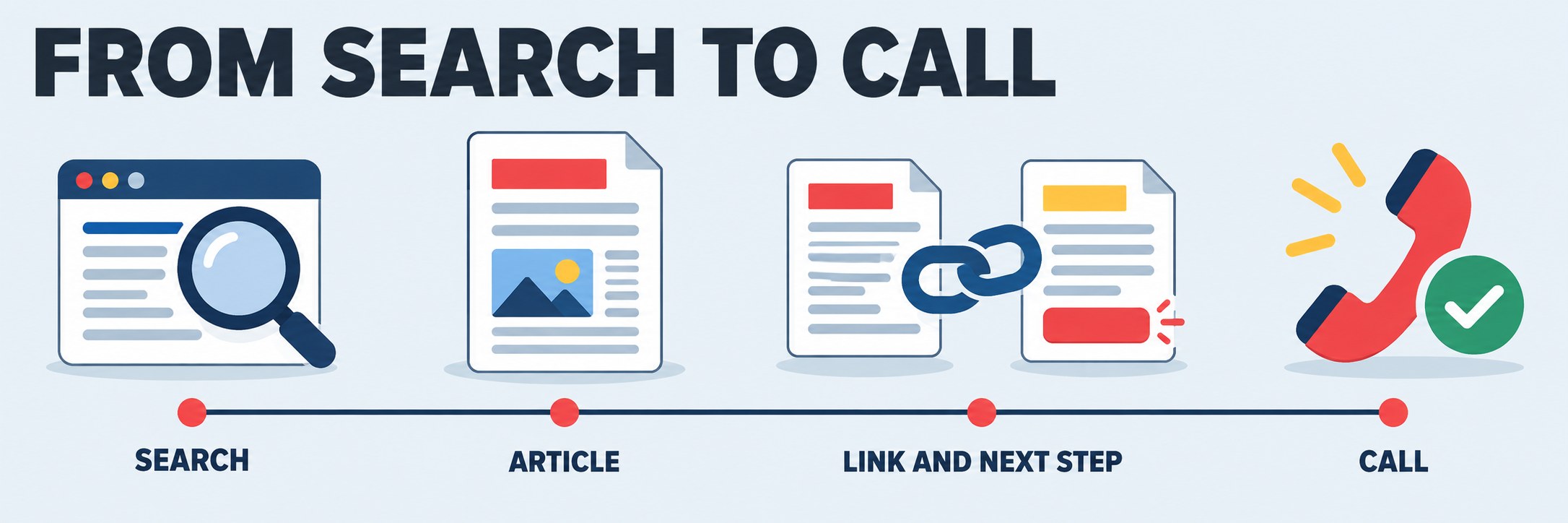
A timeline with four stops from search to call: search, article, link and next step, call.

Frequently asked questions about content marketing


How much does content marketing cost in Kansas City?

Blog post services are part of every plan on the pricing page, from the Basic plan up, and a standalone article or refresh is quoted after I read what you already have published. The read comes first because the first month is usually spent on the articles that already exist.


How often should a small business publish?

As often as there is a search worth answering, and no more. For most Kansas City businesses that is one to two articles a month plus one refresh, decided from Search Console each month rather than from a quota.


Do blog posts actually bring customers?

Only when four things are true: the topic has a search behind it, the article is linked from pages people reach, it ranks on page one, and it ends with a next step. My own blog's ninety days on this page show what happens when they are not. When they are, the article is the page a customer reads before calling.


Do you do social media posts?

Yes, as distribution. Each article becomes posts for the channels your customers use, pointing back at the article and the service page. Social media management on this site lives inside content marketing, because a post that sends people to a page that cannot convert them is a cost, not a channel.


Can you fix the articles we already have?

The articles you already have get refreshed and linked, not rewritten. The oldest post on this site, What is a website?, is the example: it is seen more than any page here and it is the first one on the refresh list.


Contact Us


Field is required
Field is required Incorrect email
Field is required
Field is required
Field is required
Your message was sent successfully
Sorry, your message was not sent