Spring Hill KS, 66083

- Home
- > Blog Main Page
- > Analytics & Tracking
- > Most funnels are a form and a hope
Most funnels are a form and a hope
04.09.2026
DoveWebConsulting
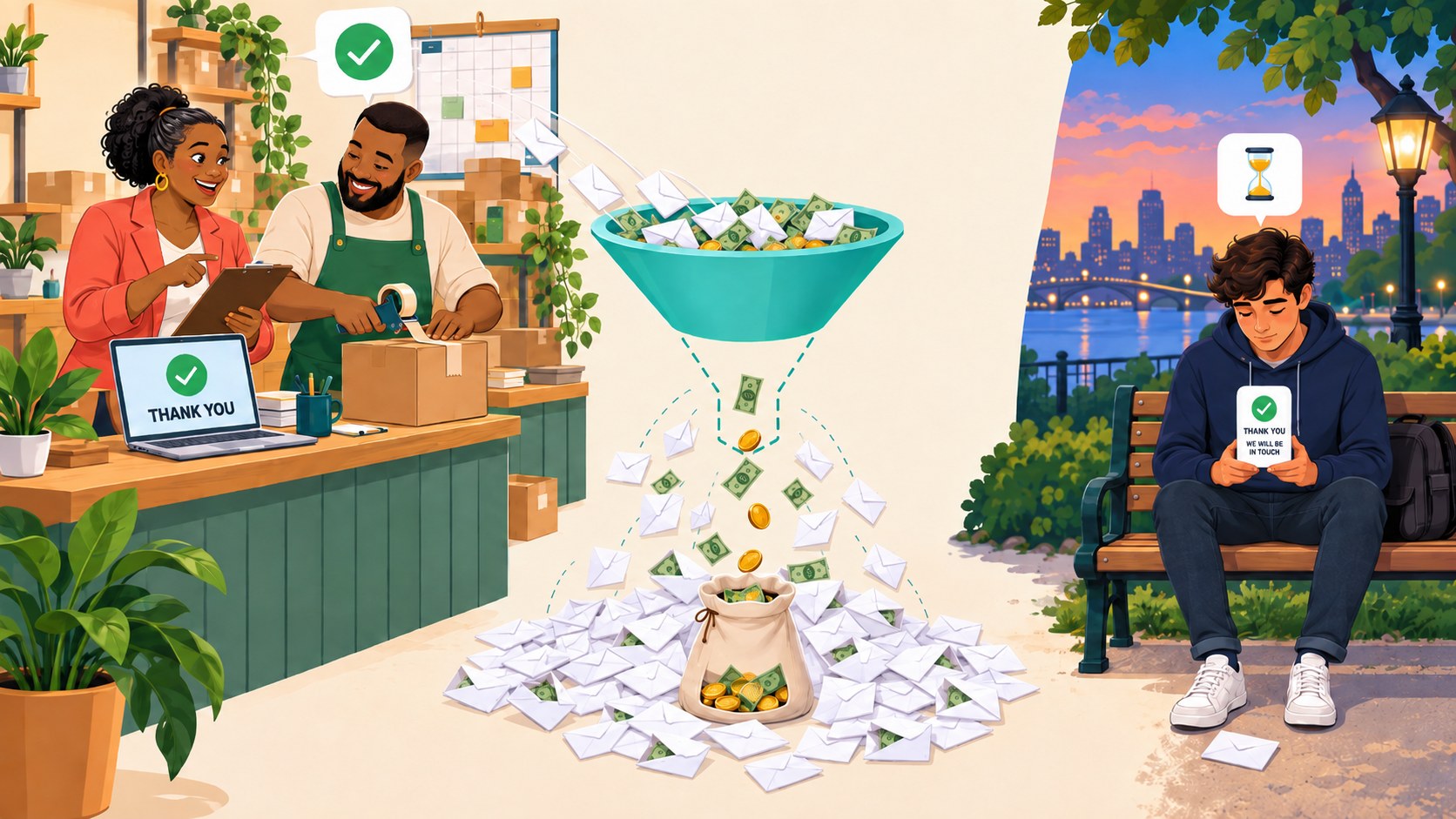
Somebody built you a funnel. You remember signing off on it.
So you have a page with a form. When the form is submitted, a second page says Thank you; we will be in touch. An email goes somewhere. Most weeks, somebody eventually calls the person back.
That is the whole thing. A form, a thank-you page, and a hope that the part in between happens.
It is the same whether you run a dental practice, a law firm, a plumbing company or a consultancy that helps leadership teams. The words on the page change. The shape underneath does not.
You have never called it a hope, because nobody has asked you the one question that exposes it. Not "how many leads did we get." You know that number. The question is: how many people started the form, how many finished it, how many were called, how many were called within an hour, and who, by name, owns each of those handoffs?
If you can answer that from memory, you have a funnel. If you had to ask someone, you have a form and a hope. Almost everyone has a form and a hope.
What a funnel is, in plain words
Every guide agrees on the first half. A funnel is the path a person takes from the moment they first hear of you to the moment they pay you. It is drawn as a funnel because fewer people reach each step than reached the one before. A hundred people see you. Thirty look closer. Ten ask a question. Three say yes. Draw those numbers as bars, and you get the shape.
That is true, and it is why the word stuck. It is also where almost every guide stops, as if the shape were the point.
The shape is not the point. The count is the point. Here is the whole definition, and everything else in this article hangs off it:
A funnel is named stages, a measured drop between each, and one owner per handoff.
Named stages, so you can say where a person is. A measured drop, so you can see where they leave. One owner per handoff, so somebody is responsible for the joint where one stage hands the person to the next. Take any one away, and you have a diagram, not an instrument. That is what a funnel is for: the one drawing of your business that tells you where the money is leaving, and whose job it was to catch it.
The stages, named: top, middle and bottom of the funnel
The textbook names are Awareness, Interest, Decision, and Action. Some models expand that to five or six, adding Consideration, Evaluation, or Retention. All of them fold into the three bands every guide uses: the top of the funnel, the middle, and the bottom.
Those names describe a stranger's state of mind, not anything you can count on a Tuesday. So here is the same funnel translated into the states a person actually passes through on a small business website, which is the version you can count:
| Textbook stage | What it is on your site | What you can count |
|---|---|---|
| Awareness | They landed on the page that has your form | Visits to that page, and from where |
| Interest | They started the form | Form starts |
| Interest, still | They submitted the form | Form submissions |
| Consideration | A human contacted them | Contacts made |
| Decision | They were contacted inside one hour | Contacts inside the hour |
| Action | It became a conversation worth having | Conversations, quotes, accepted quotes |
Six states, each a number you either know or don't. The next three sections walk the bands one at a time: what is happening, what to count, who owns the bridge out, and what belongs there.
Top of the funnel: they do not know you yet
The top of the funnel is everyone who has the problem you solve and has never heard your name. A homeowner with a leaking shower. A parent whose child needs braces. A founder whose leadership team keeps missing the same quarter. A person served with papers on a Friday afternoon. They are not looking for you. They are looking for an answer, and they type it into a search box, ask a friend, or scroll past an ad.

What they meet at the top is your content: the page that answers the question they typed, the post a friend forwarded, the ad that named their problem before it named your service. The guides call these awareness assets: blog posts, guides, checklists, short videos, a calculator that gives them a number. What they have in common is that they give before they ask. A top-of-funnel page that opens with a pitch is a bottom-of-funnel page in the wrong place, and it empties the top.
What you count at the top is simple, and most people already have it in a report they never open: how many people landed on the page with your form, and where they came from. That is the one number the top owes you.
The bridge out of the top is the form itself, or the phone number, or the booking button. Somebody owns that bridge, whether or not anyone has said so: whoever decides what the page asks for and how hard it is to answer. On most sites, that is nobody, which is why the form asks eleven questions when a name and a number would do.
How the top fails: traffic gets bought for a page nobody has measured. The lead funnel, the lead magnet, the landing page, all the top-of-funnel words you have heard, describe ways of filling this band. None of it matters if the bridge out of it is broken, and you cannot know that until you count the next stage.
Middle of the funnel: they raised a hand, now they are waiting
The middle of the funnel starts the moment a person does something on purpose. They started the form. If it did not fight them, they submitted it. Now they are in the most expensive place in your business: they have asked, and they are waiting for you to answer.

What they do while they wait is what most owners never picture. They are reading your reviews and looking at the competitor they found under you. A patient is comparing two practices' booking pages. A client is reading the law firm's intake email and deciding whether it felt personal or templated. A leadership team is asking whether the consultancy that said "we will be in touch" meant this week.
What you count in the middle is the sequence the top-of-funnel report cannot see: submitted, contacted, contacted within one hour. Three numbers, and the drop between each. Submitted to contacted tells you whether the handoff from the form to a human works. Contacted to contacted within an hour tells you whether it works while the person still cares. The hour is not a rule. The person is comparing you with somebody else right now, and the first one who sounds human tends to get the conversation.
The middle has two bridges, which is why funnels die here. The first is from the form to a human: who gets the notification, and what they do with it. The second is from that human to the follow-up: the call, the text, the second email when the first went quiet. Each bridge needs a name. Not a department. A person. If the answer to "who owns the form notification" is "it goes to the office," it goes to whoever notices, and whoever notices is usually nobody until Thursday.
How the middle fails: it is not named as a stage, so it has no owner, so nobody counts it, so the drop in it is invisible. I've traced nearly every lost inquiry to this point. I will come back to that gap, because it deserves its own section.
Bottom of the funnel: the conversation, the quote, the yes
The bottom of the funnel is what guides call Decision and Action, and it is the only part most owners already watch because it has money in it. A conversation happened. A quote went out. A patient booked the consult. A retainer was signed. Or none of that happened, and the person went quiet.

What they are doing here is deciding between you and one other option, and the other option is often doing nothing. They want a number, a date, and a reason to believe the work will go the way you say. Bottom-of-funnel assets give them that: a written quote that names what is included, a reference they can call, a consultation that puts their situation on paper, and a plan for the first thirty days. For a firm or a practice, the equivalent is the discovery call that ends with a written next step.
What you count at the bottom is conversations worth having, quotes sent, and quotes accepted, with the days between each. The days matter as much as the counts. A quote that took nine days is a different stage from one that went out the same afternoon, even if both eventually closed.
The bridge out of the bottom runs from the quote to the follow-up to the close, and its owner is the person who owns the number. In a trade, that is the estimator. In a practice, whoever runs the front desk. In a consultancy, it is usually the founder, which is why the founder's calendar is the real bottleneck.
How the bottom fails: the report shows the wins and hides the went-quiets. Leads came in. Some deals closed. So the only lever anyone reaches for is the top: more traffic, more ads, a bigger form. You pour more into a vessel you have never inspected, and the drop you cannot see scales with the spend. The bottom also has a tail most small businesses ignore: what happens after the yes. A customer looked after in the first month becomes a review, a referral, and a second job. That is the far side of the funnel, and the questions at the end come back to it.
The B2B funnel has more stages, and one more bridge that eats the leads
If you sell to businesses, the same funnel is longer in the middle because more people have to agree. The current B2B model runs six stages: Awareness, Interest, Evaluation, Decision, Purchase, and Retention. Underneath it runs a second vocabulary from the sales tools: a lead becomes a marketing qualified lead, becomes a sales qualified lead, becomes an opportunity, becomes closed won or closed lost.

Strip the jargon, and you get the same three questions, with more joints. Each of those words is a handoff. Lead to qualified lead is marketing's bridge: did this person fit, and did they engage? Qualified lead to sales qualified lead is where a human validates the interest. That's the B2B version of our unnamed middle, and the published benchmarks agree it is where the biggest drop happens. Sales qualified lead to opportunity is where a real project with a scope appears. Opportunity to closed is the bottom of the funnel, with more people in the room.
A leadership and culture consultancy lives here. So do a law firm that serves companies, an accountancy, and an agency. The discovery call is the middle. The proposal is the bottom. The retention stage, which the B2B model names and the four-stage model forgets, is where a client renews or expands, and its bridge runs from delivery to the second engagement, owned by whoever writes the monthly report.
The count-and-owner test does not change for a longer funnel. It has more rows. If you sell to other businesses, use six stages instead of four, put the qualification bridge in its own row, and name it.
How a funnel works, and why the drawing lies
The drawing shows a smooth taper. People enter at the top; fewer reach each step; a few come out of the spout. The taper suggests the loss is spread evenly, a little at every stage, like weather.
The real shape has cliffs. The loss sits at the handoffs, the joints between one stage and the next, because a joint is the one place where nobody's job description says "this is yours." Inside a stage, somebody is doing something. Between stages, a person is in transit, and a person in transit belongs to nobody. I read the ten guides on page one for this term before writing this one: none asks you to count your own stages, and one names an owner for a handoff, written for a sales team rather than a business with a form and a phone.
Two named stages and zero owners
Here is what the table usually reveals, and it is the same thing on a plumber's site, a law firm's site, and a consultant's site, including mine.
There are two named stages, the form and the sale, and a long unnamed middle. The middle contains at least three real handoffs: from the page to the form, from the form to a human being, from that human being to a follow-up. None of them has an owner, because none of them was ever named as a stage. You cannot assign a person to a step that does not appear on the drawing.
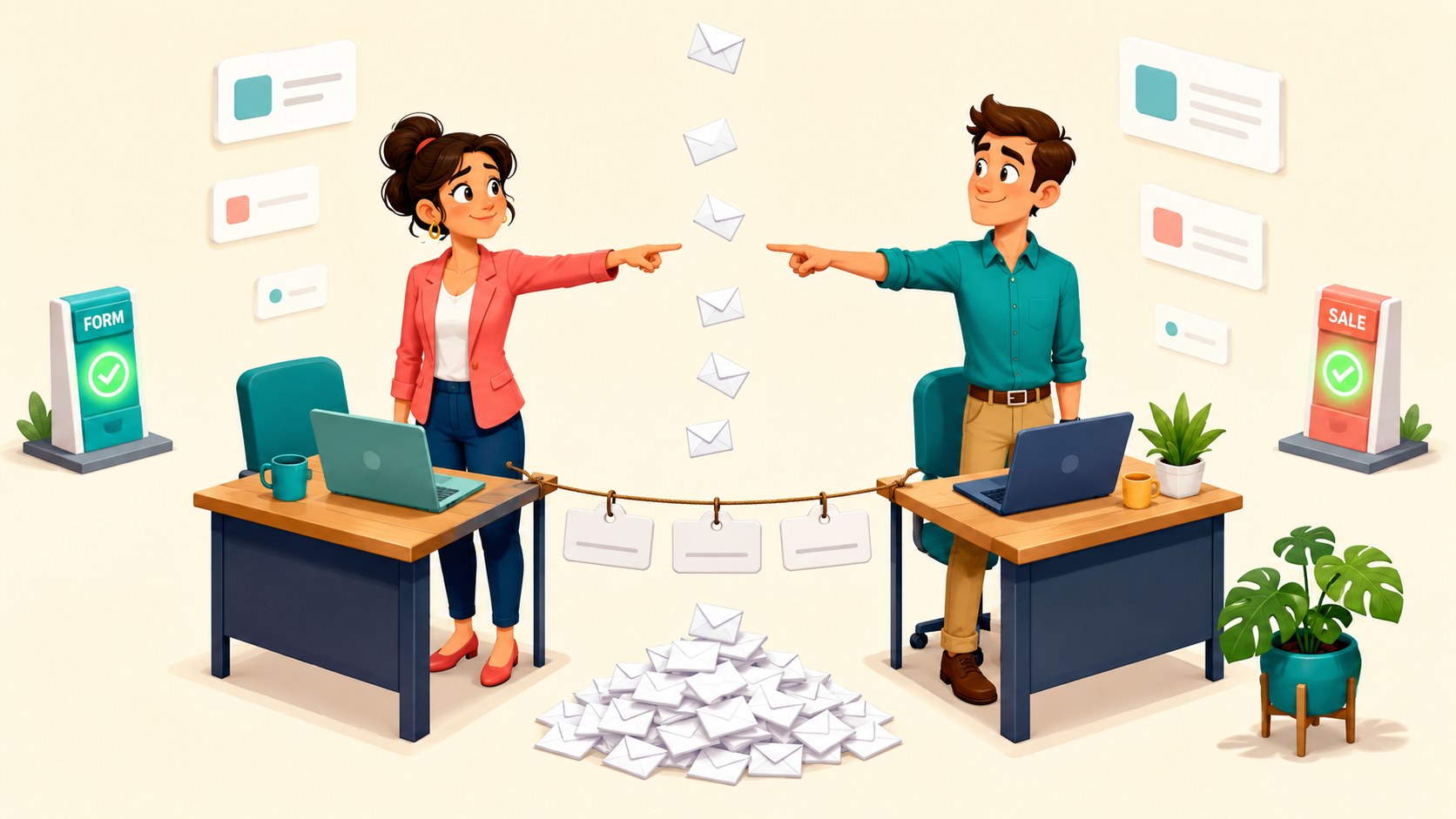
That unnamed middle is where the leads go. Not to a competitor. Not to a bad offer. They go into a gap between two systems that each assume the other one is handling it, and that gap has its own article because it deserves one: the handoff nobody owns.
This matters more than it sounds because a funnel with an unnamed middle still produces a number at the bottom. Leads came in. Some deals closed. The report looks fine.
Sales funnel, marketing funnel, pipeline, journey: which word is which
You will meet six or seven words for what sounds like the same drawing. The differences are useful.
A marketing funnel is the part before a person raises a hand: everything that turns a stranger into someone who knows you. A sales funnel is the part after: everything that turns a raised hand into a yes. Small businesses usually mean both when they say funnel, and that is fine, as long as someone owns the joint between them.
A pipeline is the seller's view of the same people: a list of open deals and the stage each is in. The funnel is the buyer's path; the pipeline is your to-do list about it. A customer journey is the whole experience from the buyer's side, including after the sale. A flywheel is the loop after the sale, where a happy customer feeds the top with referrals. A conversion funnel, or purchase funnel, is the same drawing with a different label. A lead funnel is the top half, up to the form.
And a landing page is not a funnel. It is one stage of a funnel. Whether it belongs to a funnel depends on whether somebody counts what happens after it.
Whichever word you are handed, ask the same two things. Can you show me the count at each stage? Who owns each handoff? If the answer is a diagram, you have been handed a diagram.
Your funnel, on one sheet
Fill this in from memory. Ten minutes. It shows you where your leads go.
| The step a person takes | How many people got here in the last 90 days | Who makes sure they get to the next step |
|---|---|---|
| Example: Submitted the form | 42 | Maria |
| Landed on the page with the form | ||
| Started the form | ||
| Submitted the form | ||
| Was contacted by a human | ||
| Was contacted inside one hour | ||
| Became a conversation worth having |
Then look at the blanks. A blank in the middle column means you cannot see that step. A blank in the right column means nobody is in charge of it. Every blank is a place your leads can go missing without anyone noticing.
Most people can fill in two rows: "submitted the form," because the software emails them, and "became a conversation," because they remember those. The four rows in between are the hope. This table tells you which one you own: a funnel, or a form and a hope.
Want this table as a one-page PDF?
Print it, fill it in with a pen, and keep it by the phone. Put in your name and email, and the PDF will open.
What a good conversion rate is, and what your drop is worth
The first question everyone asks once a table has numbers is whether the numbers are good. There are published benchmarks. The 2026 funnel benchmark reports put visitor-to-lead between one and five percent, and later stages between fifteen and thirty percent, with wide variation by industry and traffic source. Those ranges matter, so a two percent form rate doesn't send you into a panic.
They are also not your number. A benchmark is an average of other businesses, not yours. The only benchmark that changes a decision is your own drop between two stages last quarter, compared with this quarter. If your table has small numbers in it and somebody has quoted you a confident percentage off them, that is worth its own read: measuring a funnel when you only get thirty leads a month.
Here is the arithmetic that matters more than any benchmark, because it turns a blank into money.
People lost at a stage, times your close rate, times your average job, equals what that stage is costing you.
Take a plumber, and take the numbers as an illustration, not a statistic. Sixty inquiries a month. Eighteen never called back, because the notification goes to an inbox nobody owns on a Saturday. He closes one in three of the people he does speak to. His average job is four hundred and fifty dollars. Eighteen times a third times four fifty: two thousand seven hundred dollars a month, sitting in one blank row of the table. Thirty-two thousand a year, and not one dollar of it needed more traffic.
Now do it with your own numbers. A practice with a three-thousand-dollar treatment plan and four inquiries a week that reach voicemail after five. A firm whose intake form goes to a paralegal who left in March. A consultancy whose discovery calls take twelve days to schedule. Write the row, count the people lost there, multiply. That number is why the middle of the funnel deserves an owner before the top deserves a budget.
One warning with its own article: a form that converts and a business that does not are two different problems, and telling them apart is its own piece of work: why your form converts and your business does not.
How to build one: the three-line spec
Every "how to build a sales funnel" guide gives you the same list, and it is not wrong: build a landing page, offer something worth a name and an email, nurture the people who gave it, follow up, keep improving. Do those things. They fill the top and furnish the middle.
The problem is where the list stops. It builds stages and never names owners, so it produces a funnel that looks complete on a whiteboard but has three unowned joints. You can fix the definition in an afternoon, and you cannot fix the funnel until you do. The definition is three lines.
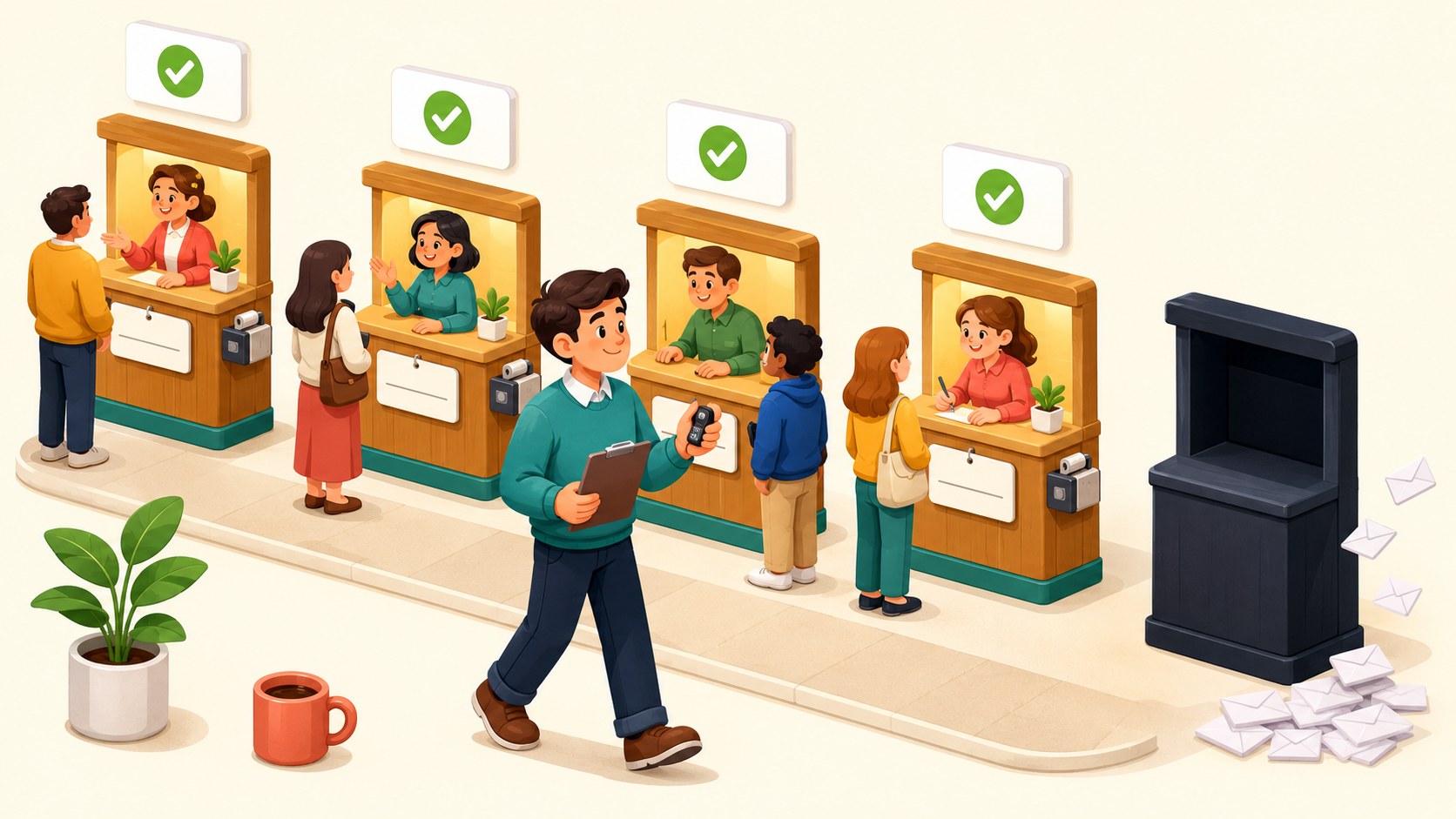
1. Name every stage. Not three. Every one. If a person can be in a state, it is a stage. Starting the form and submitting the form are different states. Contacted and contacted within an hour are different states. Write them all down, in order.
2. Count every stage. For each named stage, where does the number come from, and can you read it today? If a stage has no source for its count, that is not a measurement problem to solve later. That stage is currently a hope, and it goes on the list to fix first.
3. Name the owner of every handoff. Not every stage, every handoff. The joint between two stages is where responsibility disappears, so that is where a name goes. One person per joint. If two people share it, nobody has it.
Do those three things and you will not have a better funnel yet. You will have a funnel. That distinction is the whole article.
What does it cost? The table costs a sheet of paper. The expensive version, where an agency builds you a seven-stage machine with automation at every joint, is only worth buying after the three lines above are true, because automating an unowned handoff is a faster way to lose the person.
Is it a funnel? Twenty seconds
Three questions, yes or no. No partial credit.
- Can you name every stage a person passes through, from landing on the page to a real conversation, without leaving anything unnamed in the middle?
- For each of those stages, can you say the count from the last ninety days without asking anyone?
- For each handoff between stages, can you name the one person who owns it?
Yes to all three is a funnel. Anything else is a form and a hope, and the honest next move is not more traffic. It is the table.
When you are ready to put numbers on it instead of blanks, you can score your own funnel in about ninety seconds, and if you would rather someone else drew the table for you, request a free site analysis, and we will fill in the rows you cannot see.
Questions people ask about funnels
Do sales funnels really work? A funnel is not a tactic. It is a way of seeing your business that either exists or does not. What works is what it lets you do: find the stage where people leave and put a person on it. Businesses that do that close more of the enquiries they already get.
What is a lead funnel? The top half, from a stranger's first contact to the moment they give you a name and a number. A lead magnet is what you offer in exchange: a checklist, a guide, a calculator, an audit. A lead funnel with nobody owning the bridge to a human is the most common form-and-a-hope there is.
Can you give a funnel example? A remodeler runs an ad to a page with a quote form. Landed, started, submitted: three stages. The form notifies the office manager, who calls back within the hour: two more, with one owner. The estimator sends a written quote the same day and follows up on day three: two more, with a second owner. Every row has a count, every joint has a name, and when inquiries drop, the remodeler can say in a minute which row moved.
How much does a funnel cost? The definition costs nothing, and the software you probably already pay for. The real cost is one named person's attention at each handoff, which is also the only part that produces revenue.
Does the platform matter? Not for the definition. A CRM, a booking tool or a spreadsheet holds a funnel if the stages are named, counted and owned, and a diagram if they are not. Choose the tool after the three lines.
Is the funnel obsolete? What about the flywheel? The flywheel is the far side of the funnel: a finished job feeding the next customer's awareness through reviews and referrals. It depends on the same thing: somebody owning the handoff from a finished job to the next one. A loop with an unowned joint is a funnel with a longer name.
This is the hub. The four pieces that hang off it each take one column of the table and go deep: the handoff, the qualification, the audit, and the arithmetic of small numbers. Before any of them: Running ads with broken tracking doesn't waste your budget, because a funnel counted with a broken tag is a hope with decimals.

Use this infographic
You are welcome to republish this graphic anywhere, including commercially, as long as you credit Dove Web Consulting and link back to this article. No permission request needed.
Paste this to embed it with the credit already attached:
<a href="https://dovewebconsulting.com/blog/most-funnels-are-a-form-and-a-hope/">
  <img src="https://dovewebconsulting.com/mt-content/uploads/2026/09/funnel-twenty-seconds-infographic-dove-web-consulting-20260904_6a9a648229e76.jpg"
       alt="Funnel infographic: the twenty-second test, seven stages with their counts, owners and assets, and the table." width="100%">
</a>
<p>Infographic by <a href="https://dovewebconsulting.com/">Dove Web Consulting</a></p>
If you cannot paste HTML, this line is enough: Infographic by Dove Web Consulting, dovewebconsulting.com